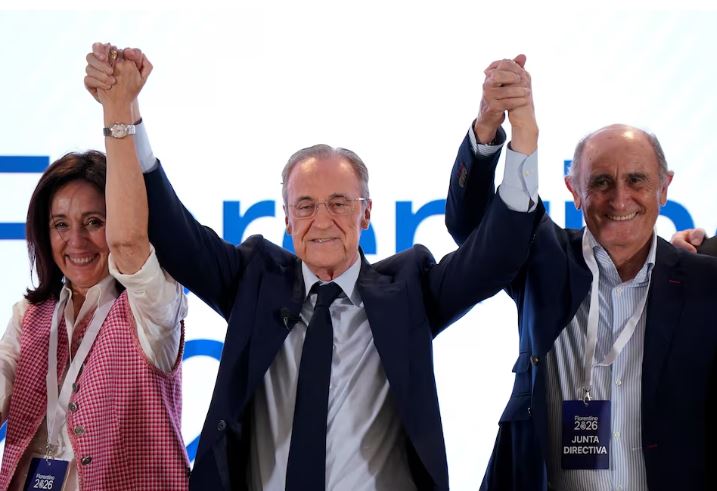
Real Madrid president Florentino Pérez has secured another four-year term after winning the club's presidential election, but the result revealed the strongest internal opposition he has faced in nearly 20 years.
The 79-year-old Pérez received 65 percent of the vote in the election held on Sunday at Real Madrid's Valdebebas training complex in Madrid. His challenger, renewable energy entrepreneur Enrique Riquelme, earned 35 percent of the votes cast by the 33,555 club members who participated.
While the result allows Pérez to remain in charge of Real Madrid, it also highlights growing dissatisfaction among a significant section of the club's membership regarding the current direction of his leadership.
First Competitive Election in 20 Years
This was Real Madrid's first genuinely contested presidential election since 2006, when Ramón Calderón won by a narrow margin.
Since returning to office in 2009, Pérez had repeatedly secured new terms without facing opposition. However, after Real Madrid finished two consecutive seasons without winning a major trophy while rivals Barcelona retained the La Liga title, pressure mounted for a more open election process.
Pérez himself announced the election on May 12 despite still having two years remaining in his current term.
Major Campaign Promises
During his campaign, Pérez promised significant sporting reforms and major investment in the squad. He stated that he would attempt to appoint José Mourinho as Real Madrid's head coach and revealed that the club was prepared to spend €150 million on a new star signing to be unveiled after the election.
He also pledged to sign defenders Ibrahima Konaté and Denzel Dumfries if re-elected.
Meanwhile, Riquelme campaigned on a platform of major change. He promised members that he would pursue the signings of Manchester City stars Erling Haaland and Rodri.
He also proposed transforming Valdebebas into a major social and entertainment hub featuring hotels, swimming pools, fitness facilities, and a 15,000-seat arena for Real Madrid's basketball team and large-scale events.
Debate Over Club Ownership
One of the most controversial issues during the campaign was Pérez's proposal to create a subsidiary company that would allow external investors to own approximately five percent of the club's commercial operations.
Riquelme strongly opposed the idea, describing it as the first step toward privatizing Real Madrid. His position resonated with many members concerned about preserving the club's member-owned structure.
However, Pérez insisted that Real Madrid's member ownership model would remain protected and that any constitutional changes would require approval from club members through a special general assembly.
A New Political Reality at Real Madrid
Speaking after his victory, Pérez described the outcome as "exceptional" and said Real Madrid had demonstrated a model of transparency and unity for the football world.
He also highlighted that he won across all age groups and claimed it was one of the strongest election results in the club's history.
Nevertheless, the fact that more than one-third of voters backed Riquelme signals a substantial demand for change within the club. Riquelme's post-election message carried a clear warning:
"Real Madrid will not wait another 20 years for an election."
The statement suggests that the era of uncontested elections at Real Madrid may be coming to an end. As Pérez begins a new term, he faces the challenge of uniting the club's membership and restoring the success that has faded in recent seasons.